The Exchange Upgrade
The Exchange Testnet is coming online, and with it comes the Exchange Upgrade. The Exchange becomes the source of truth

The Exchange Testnet is coming online, and with it comes the Exchange Upgrade. The Exchange becomes the source of truth

NexusEVM is a fully EVM-compatible L1. If you've deployed on Ethereum or any EVM chain, the tools


The Nexus OS is the operating layer for a new kind of market structure where compute, markets, and identities run on proofs, not promises.
This roundup highlights five pillars now shaping the Nexus experience —leaderboard, ecosystem, nodes, rewards, and explorer — and shows how they fit together as one coherent system.
The new Nexus Leaderboard is live and built to recognize top contributors, spark friendly competition, and make every week a fresh race to the top. Everyone starts at zero each week. As you contribute compute, you rise through leagues and see exactly where you stand across the global network.
Your league is determined by points earned in the current week via the Nexus web app or CLI. Find the Leaderboard in the Nexus web app (desktop and mobile) under “Leaderboard.”
Today the leaderboard celebrates contribution, but over time, placement may influence opportunities and rewards.
 Sam Welch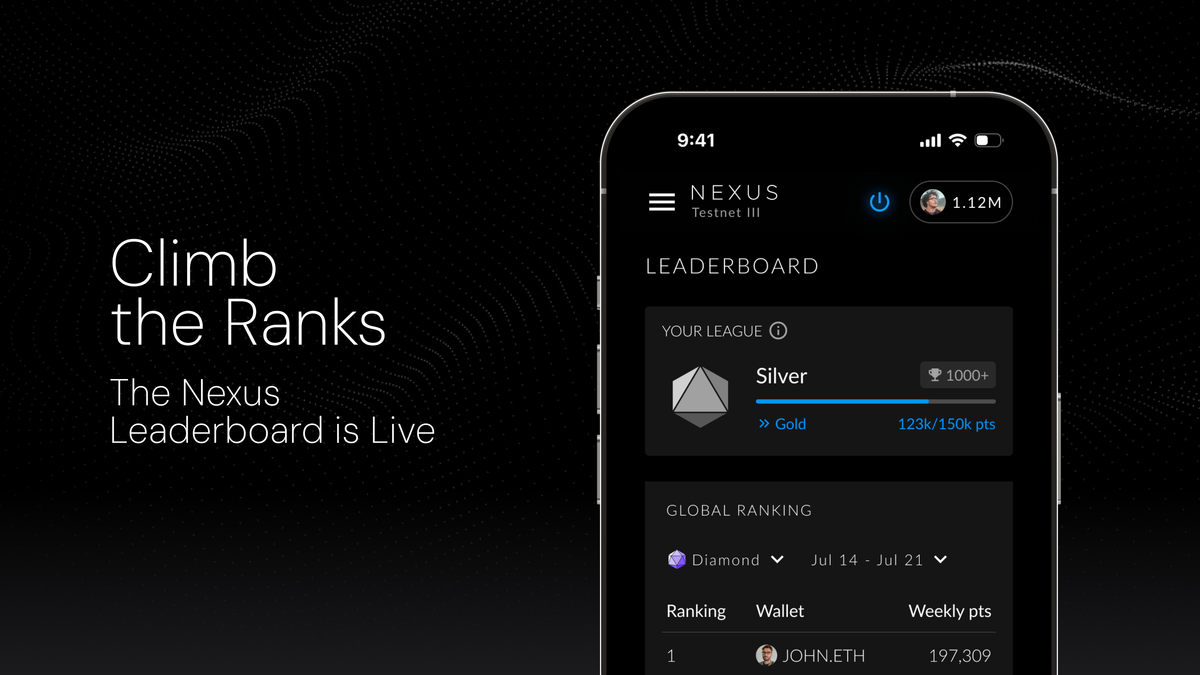
In just over a year, Nexus has grown into one of the most ambitious experiments in verifiable computation.
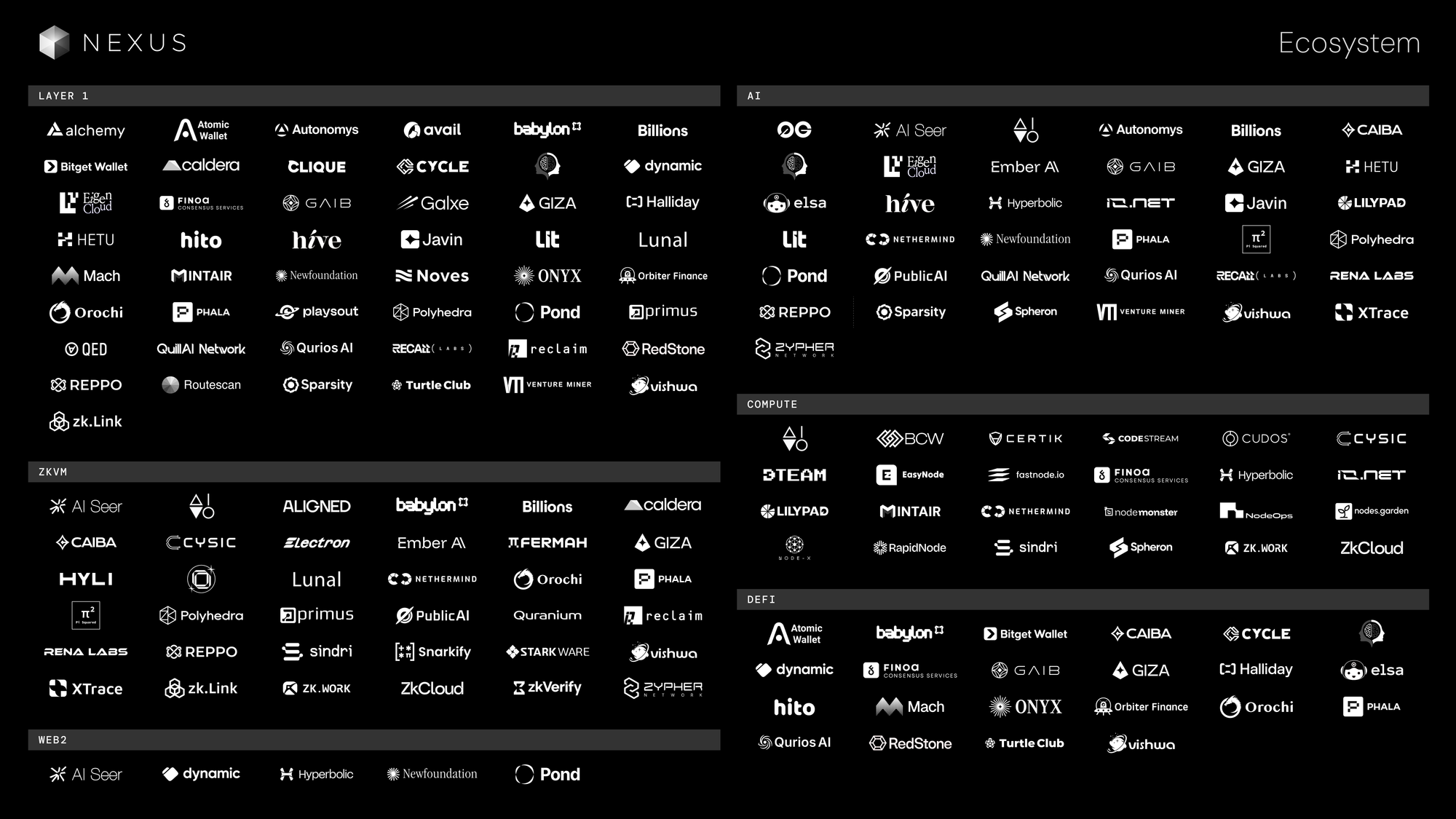
What began with a small group of cryptographers and engineers is now a rapidly scaling ecosystem — nearly 100 partnerships spanning zero‑knowledge tech, AI, compute, DeFi, Layer‑1s, and Web2.
These partners help extend our reach, integrate new technologies, and bring Nexus to high‑quality teams and communities worldwide.
 Steve Yu
For contributors who want precision, automation, and performance, the Nexus CLI is the fastest on‑ramp to contribute compute.
The browser app keeps entry frictionless. Both CLI and web talk to the same Orchestrator and earn identical rewards. The ability to connect you nodes in the Nexus OS means you can run CLI and web nodes, all while keeping an eye on everything.
Bottom line: whether you’re a weekend hacker or an enterprise ops team, the CLI gives you a clean path from zero to your first verified proof — in minutes.
 Daniel McGlynn
A new progress bar in the Nexus web app shows every step your device takes while contributing compute. It’s a small UI change powered by deeper upgrades that improve access, rewards, and how proving works.
If the blockchain is the infrastructure, the explorer is the interface. It turns raw blocks and cryptographic state into human‑readable insight — so anyone can see what actually happened onchain.
It’s a search engine and analytics dashboard for a chain. You can look up transactions, addresses, blocks, contracts, and tokens — and understand fees, confirmations, and activity patterns.
As more of life moves onchain, explorers will become essential interfaces for verification and insight. They bring readability to transparency.
 Daniel McGlynn
Put together, these pieces form the Nexus OS:
From Testnet milestones to a production‑ready stack, the direction is clear. As we look to mainnet, the invitation is open: contribute compute, build applications, and help define markets that run on proof.

NexusEVM is a fully EVM-compatible L1. If you've deployed on Ethereum or any EVM chain, the tools

The difference between human and agent transaction patterns is not linear. It is exponential — and most infrastructure teams have not run the numbers.

A conversation with Maggie Love, the founder of SheFi, about six years of building one of crypto's largest

Hank Korth has watched a lot of distributed systems cycles come and go. A professor in the Department of Computer