Exponential Episode 27: 3/17, Infrastructure, and AI
Nexus founder and CEO Daniel Marin appeared on the Exponential podcast this week to address the company's decision

Nexus founder and CEO Daniel Marin appeared on the Exponential podcast this week to address the company's decision

If you've been paying attention, you probably saw that we were building toward 3.17. You made a

A conversation with Nexus founder and CEO Daniel Marin at ETH Denver ETHDenver this year felt different. The speculative energy

In 2025, Nexus moved from early momentum to structural foundation. What began as a cryptographic vision has become a global movement: a network of millions contributing compute and shaping a new kind of financial infrastructure.
Here are the moments that defined the year:
We kicked off a global initiative to bring more people into the mission of cryptographically-backed verification. The Nexus Ambassador Program invites both technical builders and community-focused catalysts to contribute to the ecosystem — from writing zkVM tutorials to leading zero-knowledge discussions around the world.
 Nexus
Nexus
We unveiled the Nexus Layer 1 — a new blockchain designed to unify the world’s compute power and condense the Internet into a single, verifiable proof. It marks the beginning of a bold new phase for the Nexus Project. Alongside this, we launched Testnet II to begin validating the architecture that will power verifiable computation at planetary scale.
Testnet II introduced major upgrades to the Nexus network, including wallet connect, a global leaderboard, and the debut of NEX Points — a new reward system for compute contributions. Participants could track performance, manage nodes more efficiently, and earn points across browser and CLI setups. This testnet marked a critical step toward integrating the Nexus Layer 1 blockchain into the core infrastructure.
 Nexus
Nexus
Testnet II marked a breakthrough in the evolution of the Nexus Supercomputer. Over 4.5 days, 2.1 million people joined the network, contributing 112 quadrillion FLOPS of compute power and launching over 325,000 smart contracts. Testnet II validated our vision of a global, high-performance verifiable compute layer.
 Nexus
Nexus
We unveiled Nexus zkVM 3.0, a next-gen zero-knowledge virtual machine rebuilt from the ground up for speed, modularity, and formal rigor. With a new architecture, RISC-V support, and integration with StarkWare’s Stwo prover, zkVM 3.0 is ~1000× faster than previous versions. It features a formally specified design, open-source implementation, and a streamlined Rust SDK — making it easier than ever for developers to build verifiable applications.
 Samuel Judson
We launched a new series to explore the deeper societal shift behind our mission: moving from claims to proof. As AI blurs the line between real and fake, verifiability offers a path forward — one where trust is rebuilt through cryptography, content provenance, and transparent execution. This first post outlined why verifiability is no longer optional, and previewed upcoming deep dives into machine learning, media, identity, and more.
 Daniel McGlynn
At ETHSF, Nexus CEO Daniel Marin reframed verifiable computation as the next major paradigm shift in computing. He introduced the Nexus Layer 1 as a minimalist, proof-centric architecture and highlighted zkVM 3.0’s 1000× speedup as a foundation for a global supercomputer. The talk culminated in the idea of a “proof singularity,” where verifiability and AI converge to scale both intelligence and trust.
We introduced the Global Activity Map, a real-time, interactive globe that brings the Nexus network to life. Users can now see live node activity, peer-to-peer connections, and block data across continents. We also rolled out social onboarding tools, enabling participants to link profiles, follow friends, and unlock contribution-based rewards.
We shared an in-depth look at the Nexus Layer 1 Execution Layer, a new architecture designed to scale verifiable computation to the limits of global demand. By embedding a zkVM inside every node and coordinating them through recursive proofs, Nexus transforms the network into a composable, incrementally verifiable supercomputer.
 Daniel McGlynn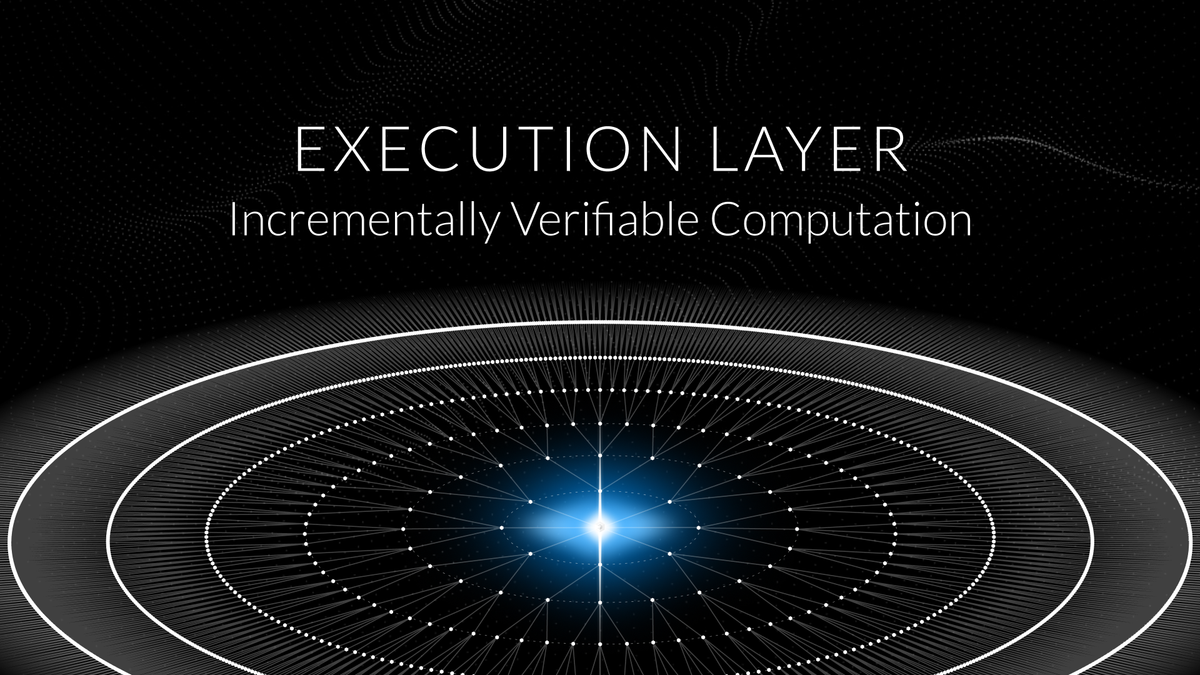
We kicked off Testnet III to demonstrate how Nexus is building the first blockchain designed to scale execution, consensus, and storage as separate supercomputer systems.
 Nexus
Nexus
We officially launched Testnet III worldwide, marking the final proving ground before Mainnet. Designed for broad participation and long-term testing, this phase introduced easier onboarding, CLI access, and real-time contributor leaderboards.
 Nexus
Nexus
Testnet III demonstrated that a global, verifiable supercomputer can be powered by anyone, anywhere. With over 2.6 million participants and 823,200 peak nodes online, Nexus validated the accessibility, scale, and momentum of its Layer 1 blockchain. Enhanced orchestration, real-time stats, and seamless onboarding made this the most usable testnet yet.
 Daniel McGlynn
In a feature episode of Exponential, Nexus zkVM lead Samuel Judson explored why zero-knowledge cryptography is becoming foundational to how software systems are built and trusted. His vision: a world where ZK proofs are as easy to integrate as an API call, enabling trust at the speed and scale of modern computation.
A new roundup post detailed the evolving Nexus OS, which is becoming an interface layer for contributing compute, tracking progress, and accessing other aspects of the Nexus network. Key updates included a weekly leaderboard for contributors, deeper CLI support, smarter reward systems, and an onchain explorer for transparency.
 Daniel McGlynn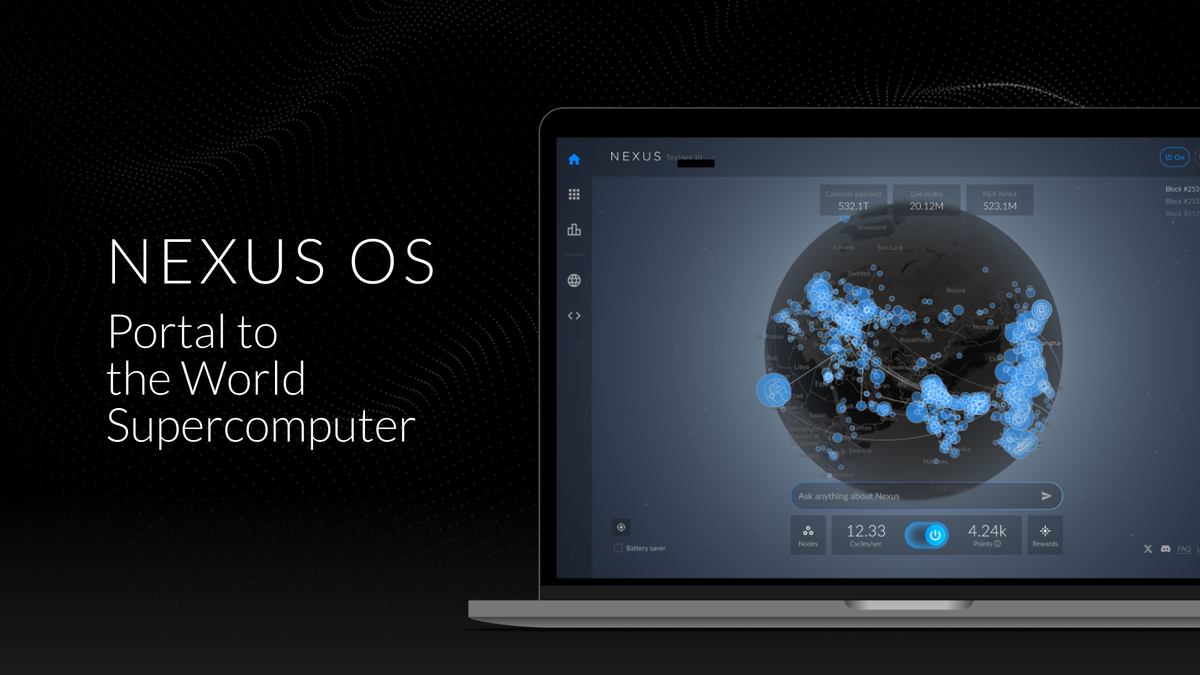
We announced Nexus’s transition from proving infrastructure to financial infrastructure. With over 3 million users, 5 million nodes, and 80 million transactions conducted, the network is battle-tested and production-ready. The next phase introduces enshrined financial applications, validator onboarding, and zkVM 4.0 — paving the way for programmable, trust-minimized markets.
 Nexus
Nexus
Nexus introduced its architecture for coprocessors — protocol-native applications that bring core financial primitives into the base layer. Unlike smart contracts, coprocessors are embedded into the execution logic, enabling faster, more composable infrastructure for trading, lending, and token issuance.
 Daniel McGlynn
We launched the Alpha version of Nexus DEX, a high-performance decentralized exchange for perpetual futures. This early release kicks off co-development with the community, with plans to progressively integrate cryptographic proofs and advanced trading features.
 Daniel McGlynn
We unveiled the technical foundation of Nexus DEX Alpha — a verifiable, high-performance exchange built directly into the Nexus Layer 1. Powered by enshrined co-processors and a three-layer architecture (execution, verification, consensus), the DEX offers composable liquidity, native matching engines, and sub-second finality.
 Daniel McGlynn
A new analyst report from Messari positioned Nexus as the architectural foundation for a more transparent financial system. It highlighted the platform’s three-layer design and emphasized verifiability as a design principle, not just a feature. The report called out Nexus DEX as a proof point for real-time, trust-minimized finance.
 Daniel McGlynn
From zkVM innovation to real-world trading infrastructure, 2025 was a year of acceleration and proof. In 2026, we move from readiness to reality: Mainnet, expanded coprocessors, and the emergence of verifiable finance as an open, programmable substrate for global computation and trading.
Join us in what comes next.

If you've been paying attention, you probably saw that we were building toward 3.17. You made a

After several months of steep acceleration, November reads as a month of consolidation for the Nexus proving network. Some indicators

A verifiable DEX, built for you Crypto exchanges weren’t built for traders — they were built for volume. For too

Finance is the beating heart of modern civilization. It allocates resources, measures risk, and fuels innovation. Yet the infrastructure that