Building on Nexus: A Developer's Starting Point
NexusEVM is a fully EVM-compatible L1. If you've deployed on Ethereum or any EVM chain, the tools

NexusEVM is a fully EVM-compatible L1. If you've deployed on Ethereum or any EVM chain, the tools

Introducing NEX, the native digital currency of the Nexus blockchain. Token details * Ticker: NEX * Total Supply: 100 trillion Token distribution

An economic machine built on the integration of three financial primitives: the Nexus Layer 1, the Nexus Exchange, and USDX.


Composability has no real analog in traditional finance. On programmable blockchains, programs can call each other's logic, share state, and pool liquidity — producing outcomes where the whole is genuinely greater than the sum of its parts.
Traditional financial infrastructure is built to resist this. Clearing systems, settlement rails, custodians, and exchanges each operate as silos. Composability, as a design principle, is absent.
Blockchains change the equation. Expressive, verifiable computation makes finance programmable and composable at the protocol level.
The design space here is wide and largely unexplored — and the gap between what sophisticated traders want and what decentralized infrastructure actually delivers is still substantial.
Consider what DeFi operators and traders still don't have:
These gaps exist not because the ideas are bad, but because no platform has assembled the right primitives. The exchange with enough performance to support complex strategies is centralized and permissioned. The DeFi primitive with enough composability is too slow and too shallow for serious size. The stablecoin isn't integrated with the trading venue that needs it.
We believe integrating the right core economic primitives at the protocol level produces a financial substrate with properties that none of the components could achieve independently. The Trifecta is that substrate.
Nexus began as a zkVM and compute network — infrastructure for verifiable computation. That foundation now underpins the Nexus Trifecta: an economic system that combines the Nexus Layer 1, the Nexus Exchange, and USDX into a single, synergistic platform. The three components are designed to produce compounding economic properties that no independent component could achieve on its own.
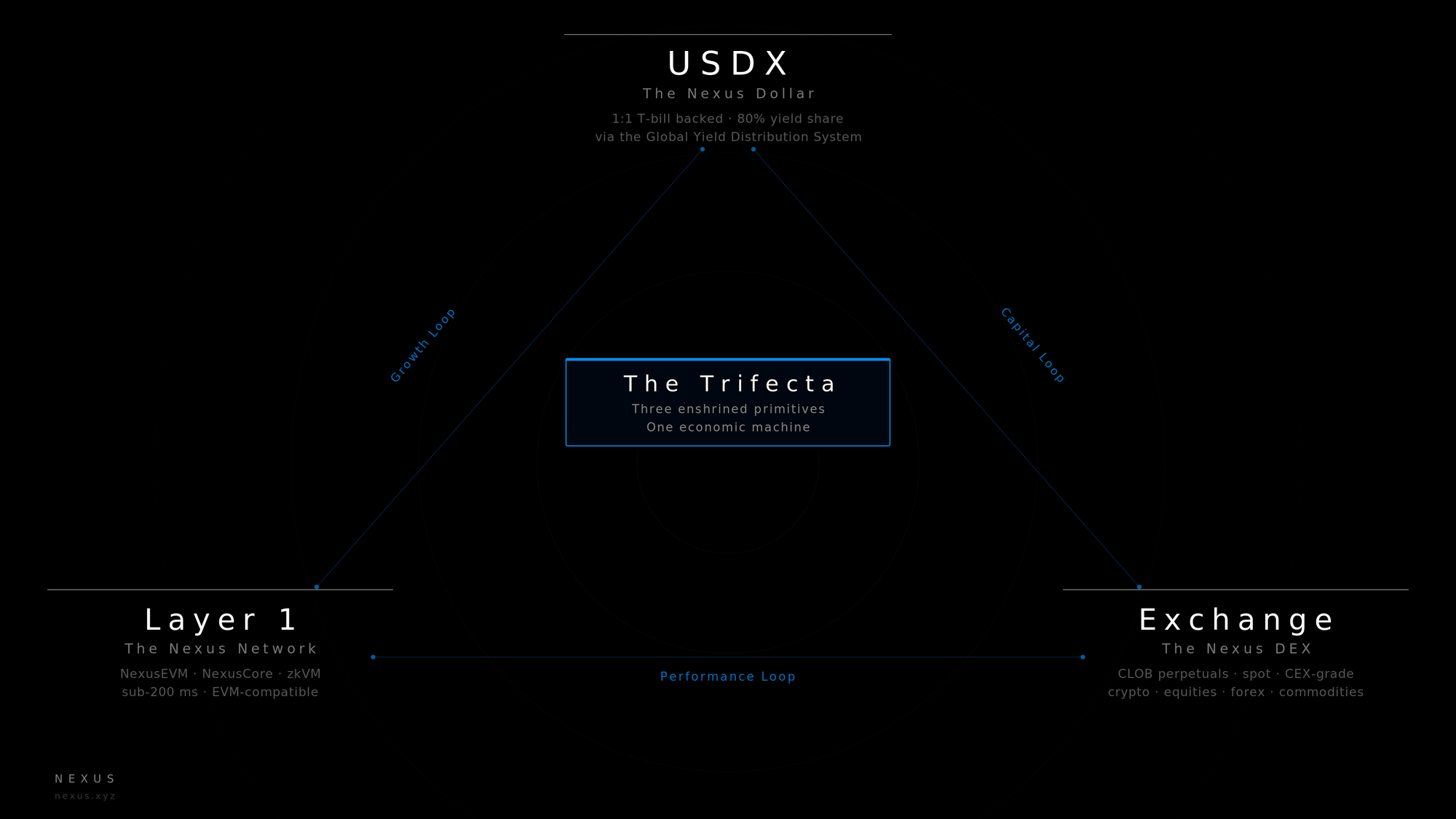
The Nexus Trifecta is built on three core economic primitives. Other projects have built dedicated chains for trading, proving real demand for onchain derivatives. A trading chain is a single-product business. Nexus is a financial landscape: a composable EVM environment hosting enshrined high-performance financial engines, a sovereign stablecoin streaming real yield back to the ecosystem, and an architecture designed to add new financial primitives over time.
Performance, extensibility, and aligned economics all become part of one system.
The Nexus Layer 1 is a blockchain purpose-built for verifiable financial computation. It will run a fully EVM-compatible execution environment: developers familiar with Ethereum can deploy contracts, compose with existing tooling, and access the full breadth of the EVM ecosystem without modification.
What differentiates it is how the Exchange is built on top of it. The Nexus Exchange runs on a centralized sequencer, an off-chain order book, and a real-time matching engine with a target processing time of under 5ms.
Position management, margining, and liquidations will target execute in real time. These are the performance characteristics of a top-tier centralized venue, made available through decentralized, permissionless infrastructure.
The Nexus zkVM provides the verifiability. Users get the execution speed of a CEX with the transparency of a public blockchain.
The Nexus Exchange is being built as a decentralized spot and perpetual futures exchange embedded directly into the Layer 1. At launch the goal is to support crypto markets and, over time, equities, forex, commodities, and any synthetic market that can be defined onchain (and of course, subject to applicable regulatory frameworks). It will become the flagship financial application on the Nexus Layer 1 — and the first demonstration of what a purpose-built financial blockchain can actually deliver.
Despite its distributed architecture, the Exchange will be designed to execute at the speed of a centralized exchange (CEX): a high-performance central limit order book (CLOB), a real-time risk engine for margining and liquidations, support for multiple order types (limit, market, conditional), and native REST and WebSocket APIs.
This means TradFi-style algorithmic and high-frequency trading strategies can be migrated directly onchain without re-engineering execution logic — and it means autonomous agents can access the full depth of the Exchange programmatically, without any human-facing interface in the loop.
What will separate the Nexus Exchange from existing onchain venues is its execution context. Running on a dedicated sequencer with an off-chain order book, it operates outside the constraints of general-purpose VM throughput.
Blocks will settle onchain and synchronize with the EVM, meaning smart contracts can interact atomically with Exchange state: placing orders, reading prices, composing strategies. The Exchange will become shared infrastructure, available to any application on the chain.
USDX will be the native stablecoin of the Nexus economy. It will be backed 1:1 by short-duration U.S. Treasury bills and cash equivalents, issued through the M0 framework via a licensed issuer. USDX is designed to be conservative in the best sense: reliable, transparent, and durable. Its mandate is deliberately narrow.
USDX will be the default margin and settlement asset for the Nexus Exchange. All trading pairs are quoted in USDX. All PnL, fees, and collateral settle in USDX.
Users will be able to create USDX from USDC or USDT at 1:1 via Ethereum-based Peg Stability Modules, giving it deep on-ramp liquidity without requiring a new token. USDX launches on Ethereum first, then extends natively to Nexus.
Beyond its role as a settlement currency, USDX is designed as the instrument through which the protocol expresses its monetary policy. The T-bill yield generated by USDX reserves will be designed to flow through the ecosystem via the Global Yield Distribution System (GYDS): a programmatic, mechanism intended to stream part of the protocol’s revenue back to builders and users.
The stablecoin landscape already has options. What it doesn't have enough of is institutional-grade dollars that are simultaneously credible to a treasury desk and composable in a smart contract. USDX is designed to be both.
NEX is the native gas currency in the Nexus Layer 1, and will serve as the key unit of value exchange in the network, including the Exchange and USDX.
The relationship between NEX and the Trifecta is straightforward. The Trifecta generates economic output and chain GDP through the interaction of the Layer 1, the Exchange, and USDX.
In other words, NEX will play a key role in protocol alignment.
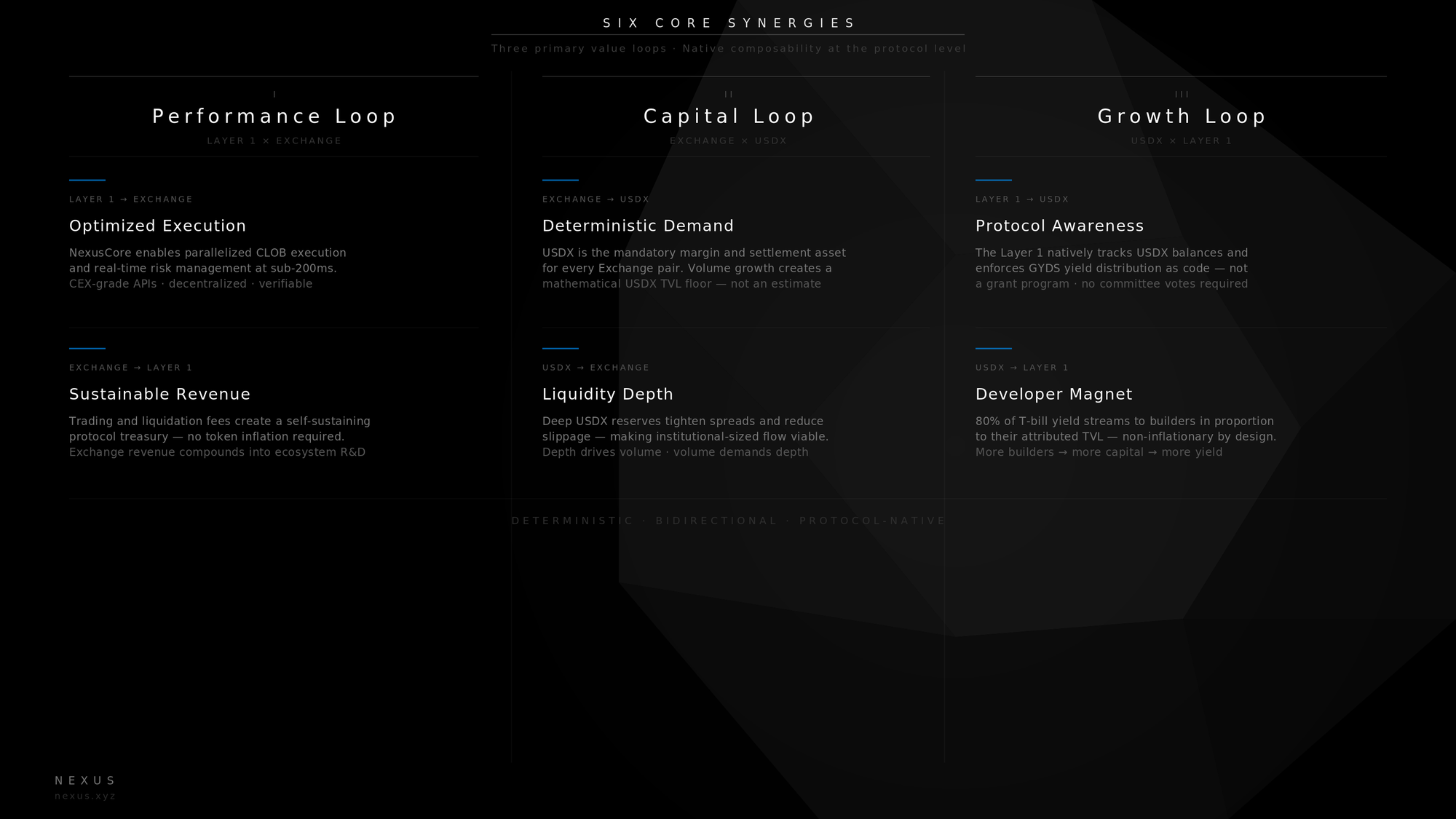
The compounding power of the Trifecta comes from its bidirectional leverage. Each component both supports and is supported by the other two. This is protocol-level integration, meaning the relationships are deterministic and designed to pass the test of time.
This loop describes the technical moat created by co-designing the execution environment and the trading venue.
A programmable, globally accessible Layer 1 fundamentally changes who can reach the Exchange's financial infrastructure. Any address — a smart contract, a vault strategy, a trading bot deployed by any operator anywhere in the world — can access the Exchange's order books, liquidity, and markets directly, without permission from a centralized intermediary.
Strategies that require institutional onboarding at a CEX can be deployed permissionlessly by any operator with the right code. The L1 is the access layer: it makes CEX-grade execution and market depth available to the entire programmable financial stack.
Unlike chains that fund operations through dilutive token inflation, the Exchange will generate high-velocity protocol revenue through trading and liquidation fees. This will create a self-sustaining economic foundation for the entire Layer 1 ecosystem. At scale, Exchange revenue will become one of the primary inputs to the protocol's treasury and R&D budget.
This loop describes the mechanical link between trading activity and capital depth.
USDX will be the mandatory quote asset and margin collateral for the Exchange. This will create a structural demand: as Exchange volume grows, USDX TVL grows with it. For every dollar of daily trading volume, a fraction must exist as USDX margin collateral. Volume growth will mechanically drive USDX demand. The 1:1 USDC and USDT pools against USDX will ensure that this demand is easily satisfiable without friction.
Deep USDX liquidity will tighten bid-ask spreads and reduces slippage. This depth is a prerequisite for institutional-sized trades. Institutional participation drives more volume, which will drive more USDX demand, which deepens liquidity further. The cycle will become self-reinforcing.
This loop describes how the Trifecta will transform the Layer 1 into a developer-centric economic machine.
USDX will be a first-class primitive at the protocol level. Rather than a grant program or a discretionary allocation, the mechanism will effectively create code-enforced monetary policy.
The GYDS will invert the traditional developer relationship with a blockchain. Rather than requiring builders to compete for ecosystem grants, Nexus will pay developers to build on its capital substrate. By streaming a portion of USDX yield back to builders in proportion to the TVL they attract, the design of the system is intended create a durable, non-inflationary incentive structure. More builders will attract more capital. More capital will generate more yield. More yield attracts more builders.
As designed, when GYDS incentives and R&D reinvestments exceed protocol operational costs in dollar terms, the Trifecta will achieve full economic self-sustainability.
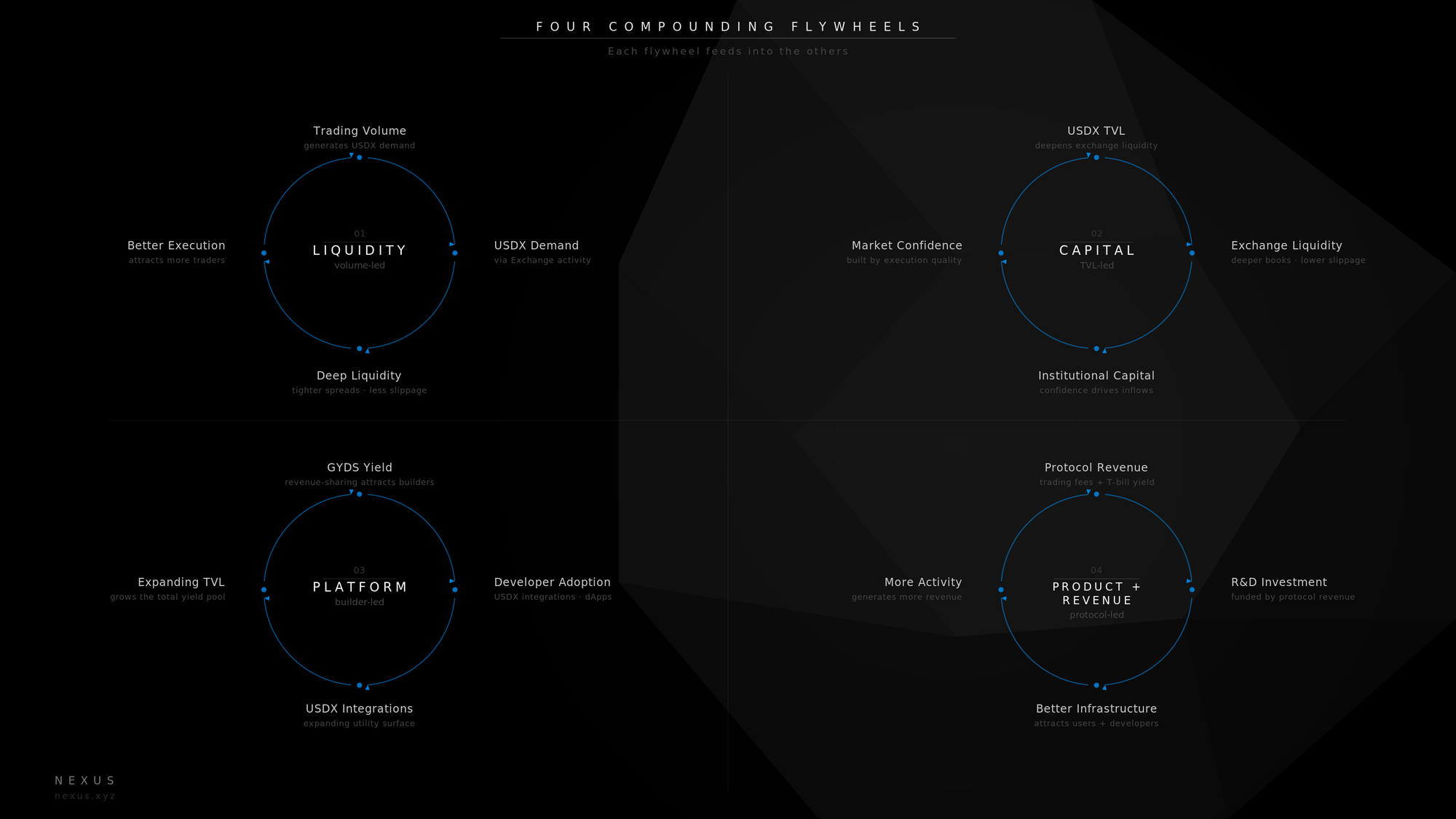
When the three value loops operate together, they will activate four compounding flywheels that drive ecosystem growth. Each flywheel feeds into the others.
The intended outcome: More trading volume will generate more USDX demand. More USDX demand will deepen liquidity. Deeper liquidity will improve execution quality and reduces slippage. Better execution will attract more traders. More traders generate more volume.
The intended outcome: High USDX TVL on the Layer 1 will deepen Exchange liquidity. Deeper liquidity will build institutional confidence. Institutional confidence draws more capital. More capital increases TVL.
The intended outcome: GYDS revenue-sharing will attract developers who integrate USDX into their applications. More application integrations will expand USDX utility. Greater utility will increase TVL. Higher TVL will expand the total yield pool. A larger yield pool will drive larger distributions, attracting more builders.
The intended outcome: Protocol revenue from trading fees and T-bill yield will fund ongoing R&D. Better infrastructure will attract more users and developers. More activity generates more revenue, while more revenue funds the next round of development.
The Global Yield Distribution System will materialize Nexus's native monetary policy. It will be the mechanism by which the protocol sustainably incentivizes economic activity without relying on inflationary token emissions or opaque grant programs.
The aggregate output of all four flywheels can be understood as chain GDP: the total economic activity generated within the Nexus financial ecosystem. The Trifecta is designed to optimize for chain GDP by aligning every participant, traders, builders, liquidity providers, and the protocol itself, around the same set of growth objectives.
In nature and computing, composability produces emergent properties: complex behaviors that arise from simple, interacting rules. The interaction of these primitives enables financial applications that no single component could support alone.
We believe the same principle applies to finance. By combining high-performance verifiable computation with enshrined economic primitives, the Trifecta creates a substrate for emergent finance: financial applications and instruments that were previously impossible, enabled by the interaction of primitives that were designed to compose.
Some examples of what this substrate makes possible:
These products and strategies will result from the consequences of building a system where the Exchange, USDX, and the EVM are all first-class, atomically composable primitives on the same Layer 1.
The Exchange and USDX will be the first components of the Nexus Layer 1, but the architecture is designed to accommodate a growing catalog of financial engines. As the ecosystem matures, additional financial engines will be proposed, evaluated, and integrated at the protocol level.
The near-term roadmap includes advanced trading vaults and lending protocols. Longer term, the platform is designed to enshrine oracles, liquid staking tokens, real-world asset infrastructure, and prediction markets. Virtually any financial application, from traditional primitives to entirely new instruments, can be materialized by developers building on the vertical integration of the Trifecta.
Each new primitive multiplies the composability surface of the ecosystem. A native lending protocol can extend portfolio margin across Exchange positions. A native oracle can feed real-time price data into EVM contracts and the Exchange without latency overhead. A native vault can auto-compound GYDS yield across multiple application sources. These interactions are strengthened with every addition to the catalog.
This is the long-term vision: an economic machine whose design space grows with its ecosystem, where the emergence of innovative and verifiable finance is constrained only by the imagination of those building on it.
We expect the mainnet launch of the Nexus Layer 1 to mark the beginning of a period of hyper-financialization, where the traditional separation between software infrastructure and capital begins to dissolve. A blockchain, properly architected, is not just a platform for financial applications. It is itself a financial machine: programmable, composable, and verifiable by design.
Finance is also moving from human speed to machine speed. Autonomous agents are becoming a meaningful class of financial actor — executing strategies, managing portfolios, routing capital — and they require infrastructure with the latency, programmability, and cryptographic verifiability to match. The Trifecta is built for both the sophisticated human operators deploying it today and the autonomous systems that will run on it tomorrow.
The Trifecta is how we build that machine.

USDX is the native U.S. dollar stablecoin of the Nexus ecosystem — a conservative, 1:1-backed instrument designed to

In today’s fragmented stablecoin landscape, many systems are either chasing liquidity or retrofitting incentives. Traders face operational complexity, developers

Stablecoins were supposed to make crypto capital efficient. Instead, they’ve multiplied complexity. Every new protocol introduces a new preferred

Nexus coprocessors are specialized, enshrined execution engines that live inside NexusCore, the high-performance half of Nexus’s dual execution